








Can Tarot Be Wrong? What It Means When a Reading Doesn’t Feel Right
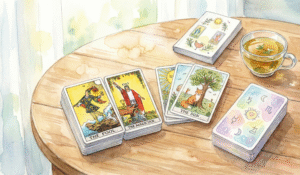
Imagine waking up on a crisp Monday morning, the sunlight streaming through your window, illuminating the chaos of the week ahead. You pour a cup of coffee, settle into your favorite chair, and decide to draw a few tarot cards for guidance. The first card you flip over should bring clarity, but instead, you feel a jarring disconnect. The image stares back at you, powerful yet vague, provoking more questions than answers. You wonder: can tarot cards be wrong?
The Complexity of Resonance
When we turn to tarot, we seek insight, validation, or direction. Yet, there are moments when the reading feels off—like trying to tune a radio only to catch static instead of the smooth melody you hoped for. In these instances, it’s important to recognize a few possible reasons why your tarot reading might not resonate.
1. The Clarity of Your Question
Your tarot reading’s accuracy often depends on the clarity of your question. If you dive into a reading with vague intentions, the cards may reveal muddled insights. Think of your inquiry as a lighthouse guiding the reading; if the light is weak or unfocused, the guidance will reflect that uncertainty.
Consider this scenario: you shuffle the deck and ask, “What do I need to know?” While a valid question, it lacks specificity. Instead, refining it to “What is blocking my career growth?” can yield more actionable revelations. Hashing out your questions in a journal before your reading not only clarifies your intentions but also prepares your mind to receive more pertinent advice.
2. Reader Bias and Projection
Another common pitfall lies in the realm of reader bias. As a tarot practitioner, I’ve found that personal projections can color the interpretation of the cards. When you approach a reading loaded with preconceived notions about what “should” come up, you may inadvertently funnel your beliefs into the cards. This bias can distort the tarot’s narrative, making the reading feel incorrect or misaligned.
For example, if you’re hoping for a romantic reading yet obsessively focus on a past relationship, your mind may highlight cards that reinforce your emotional biases rather than those that speak to new possibilities. This projection can lead to frustration, as the reading feels more like a reflection of your desires than an objective insight.
3. Timing and Readiness
Timing plays a pivotal role in our connection with tarot cards. Just as the seasons influence nature, they also affect our inner landscapes. You may draw a card that feels starkly irrelevant today, but in the right context—or timeline—it can resonate deeply. Tarot acts as a mirror, reflecting our current state, and sometimes we aren’t ready to confront the reflections it reveals.
This aspect of timing reminds me of a flower bud that refuses to bloom despite all conditions seeming ideal. Sometimes, growth requires patience—a lesson that can be difficult to accept when you’re eager for answers. If you find yourself puzzled by a reading that doesn’t feel accurate, it could be a signal that you’re not yet in a place to fully embrace the insights being offered.
4. Embracing “Wrong” Readings as Reflection Tools
Interestingly, even a “wrong” tarot reading can be a gateway to profound insights. Rather than viewing these moments as failures or missteps, embrace them as invitations to explore hidden resistance or unhealed parts of yourself. Just like a pebble in your shoe might prompt you to investigate its presence, ambiguous card interpretations can reveal areas requiring attention.
A vital part of the tarot journey is cultivating curiosity over frustration. Instead of discarding a reading that feels off, ask yourself what emotions arise in response. What feelings does the reading provoke? What aspects of your life sparkle with potential for growth? Such reflections can nurture your inner dialogue and guide you toward deeper self-understanding.
Finding Balance: Tarot and Astrology
Many tarot practitioners find that their readings become enriched through the lens of astrology. Both systems complement each other, offering insights into how the energies of the moment can influence the interpretation of the cards. By integrating astrological awareness into your tarot practice, you can gain contextual insights rooted in cosmic trends.
For example, when the Moon is in reflective Cancer, drawn cards may reveal your emotional depths, whereas a dynamic Aries Moon might prompt you to take action based on your reading. The energies at play can help you navigate how to understand the messages the cards convey and when may be the best time to act on them.
For those interested in exploring connections between tarot and astrology, there are numerous resources that can help deepen your practice.
Заключение
As we navigate the nuanced world of tarot, it’s vital to approach our readings with both honest intention and open curiosity. Yes, tarot readings can feel wrong at times, but embracing these moments as part of the greater journey can unlock unexpected clarity. In this intricate dance between you and the cards, patience and reflection may yield insights that initially elude you.
Ссылки
- Joan Bunning – Learning the Tarot: A Tarot Book for Beginners – 1998
- Liz Worth – Going Beyond the Tarot: A Guide to Tarot and Self-Discovery – 2020

 Russian
  English
  Czech
Czech  Spanish
  Portuguese
  French
  Italian
  German
  Dutch
Dutch  Polish
  Norwegian
  Swedish
  Romanian
  Finnish
  Turkish
  Danish